Thursday, 14 November 2013

Why United need wingers as Moyes steadies the ship


David Moyes has now steadied the Old Trafford ship after some troublesome waters thanks to the Premiership fixture list. Since that defeat to West Brom, United are unbeaten in 9. Although the performances have not been glamorous majority of the time, they have been somewhat effective. Many people speculated as to how United would change under Moyes and if truth be told looking at the statistics, not that much has changed in terms of style.

Last season United struggled in wide areas, for the first time under Ferguson the strength of United was not out in the flanks. Moyes did not make any recruitment in the wide areas so this has been a regular pattern of play for United. Rooney and Van Persie are the focal points of the team, both the main sparks and the main threat for United.

Whatever happened between Moyes and Rooney it is clear to see that Rooney is galvanized. He and Van Persie have had almost identical patterns this season. Both have played 10 games in the league with 1 appearance coming from the bench. Van Persie with 7 goals has 2 more than Rooney, but Rooney has 2 more assists than Van Persie. According to whoscored.com the five best domestic performers for United have been Evra, Rooney, Van Persie, Januzaj and Vidic.

One thing that immediately strikes you is the absence of midfielders from the top 5. This again was a pattern last season under Ferguson. Manchester United’s midfield strength now comes from their ability to hold onto possession. This allows United to see out narrow leads through defence by ball possession.  Michael Carrick has no assists so far, but last season was his best in a United jersey. He has developed into a very clever player, breaking up the game through interceptions thanks to his clever positional sense. This season he is averaging 4 interceptions per game which is the second highest in the league. Carrick also is second this season in the average passes league, hitting on average 77 per game, 5 behind Yaya Toure. With Carrick now out for a few weeks Manchester United have a slight problem, and they may by relying on Darren Fletcher returning ahead of schedule or else Fellaini finally settling. In Cleverly United have a clever (pardon the pun) passer who is capable of retaining possession for his side through shorter less ambitious passes. With a pass completion of 89.7% he is United’s most accurate passer this season.

What next for United? With each game they win confidence grows for United. The win against Arsenal threw them straight back into the title race and with the experience held by the United squad you wouldn’t bet against them being contenders. Undoubtedly Moyes will be given time to build his team, if he is to continue with the 4-4-2 come 4-4-1-1 formation he favours then he will have to identify targets to improve United’s creativity out wide. United are too reliant on Van Persie and Rooney creating their own chances and working together without much more forward support. In a few of the big games this season the likes of Kagawa, Young, Valencia and Nani have been ineffective and this has handicapped United. Many fans grumble about the lack of creative quality centrally but it is actually working well for United, with two disciplined players they are getting control of games. They have had half a percent less average possession than Arsenal this season and more than Liverpool, so midfield control of games as well as that match winning strike force is by far Moyes’ greatest strength.  Consistency, confidence and smart recruitment out wide should provide a good platform for the future at Old Trafford.

Tuesday, 8 October 2013

Roma start the season strongly with Totti the usual suspect


A.S Roma are somewhat an enigma this season.  They have started with a 100% record after 7 games. They finished last season strongly and where originally tipped to start the season strongly especially after the introduction of former Lille manager Rudi Garcia as the new man in charge. However the start of this season saw an exodus of key players. Stekelenburg joined Fulham, PSG swooped for Marquinhos, Barcelona chose to buy back Bojan, previous top scorer Osvaldo left for the south of England with Southampton and Spurs bought the outrageously talented Lamela. Many people believed that this exodus of talent would set Roma backwards, all but two of their key assets where shown the door.


However the total value of the sales brought in just over €100 million for the Italians, this was a real testament to the reactive nature of Roma in player recruitment and this money was invested very shrewdly by Garcia in the replacements he brought in.


Italian cap Morgan De Sanctis replaced the Fulham bound Stekelenburg, Maicon was brought in after an unsuccessful spell at City on a free, Adem Ljajic came in from Fiorentina in a real coup for Roma,  replacing Lamela.  Another coup was landing PSV star man Kevin Strootman, reportedly beating Manchester United to his signature. Defensively the excellent Marquinhos was replaced by Mehdi Benatia from Udinese and Tin Jedvaj  was brought in from Croatian cracks Dinamo Zagreb. The other two big signings where Destro from Genoa and Gervinho from Arsenal.


Roma still made a profit on player sales of around €30million, and some might say looked stronger after selling all their key players and replacing them than before. Judging by the strong start to the season this already looks to be true.


Looking at this undoubted plethora of talent it would be very disrespectful to claim that Roma are a two man team, but when speaking about Roma it is undeniable that two players stand out above the rest. Danielle De Rossi & Francesco Totti. De Rossi is the highest paid player in Italy and seems to have put his troubles that affected him last season behind him and moved back in to the Roma starting eleven after falling out of favour when his form dipped. The pair are few of the last one team players which has recently become a rarity in football. Totti as he proved at the weekend in the win over Inter seems to be mercurial. Roma could exist for another 100 years and not have a player like him again. He is Roma’s greatest ever player and even now at 37 remains a key player for the side.

Despite being Italian football’s second top scorer, Totti has never been comfortable as the main focal point in the Roma attack. His strength is as a second striker, coming back to link the play, playing in between the lines. People talk about the superb ability of Lionel Messi and the creation of the new type of striker, the false nine but what many people do not realise is that at Roma especially under Luciano Spalleti, Totti was one of the first strikers to be a false nine long before the role even had that name. Italian football has always favoured the trequarista and the poacher combination.  At international level Totti was always partnered with a poacher type player, be that either Inazghi or Toni. This is reflected in the fact he only managed 9 international goals for the Azzurri. At Roma however Totti has become both the trequarista and the poacher.

His movement at the weekend against Inter was key to disrupting the Inter defence. They were unsure if they should follow him (exposing their back line) or stay put (allowing him space to run the game). Even when they got tight Totti’s superior skill and ball control meant that they could not even get close and he often brought team mates into play (as shown below.)


Also shown are two of Totti’s chalkboards from the Inter game. Totti’s variance of position is displayed in the positions he got into both to pass the ball and to receive the ball. What is amazing about him is that for all the bringing into play he does for others, he does not diminish himself as a goal threat, finishing the game with a brace in a 3-0 rout.  Even at 37 he manages to both be Roma’s key playmaker and also their key finisher.


In Britain Totti has never received the praise he has elsewhere on the continent. This might be down to the fact that at his last three international tournaments he never fully lived up to the hype. In 2002 in Korea he was dismissed as Italy crashed out, and in 2004 he was banned for a spitting incident. As Italy won in 2006 Totti was only half fit, playing with metal plates in his ankle. He finished with only one goal (from the spot) but still managed to finish with the most assists of the tournament and played in every game making him a World Cup winner.

Totti’s decision to end his international career prematurely means he has missed further chances to showcase his enormous talents on the world stage. This matters not to the Roma faithful who correctly hold him in massive regards. Totti has confirmed he will retire in 2016 at the age of 39 so time is running out for fans to see the Italian in action. He and De Rossi represent the dying embers of the breed of footballers who served one club, he is an endangered species in world football, but is still proving at the age of 37, that he is a dangerous species for opposition defences.


Tuesday, 1 October 2013

How Sergio Busquets is flourishing under a new manager


Due to the unfortunate circumstances that occurred, Barcelona where forced into another new managerial change. It has been a turbulent year or so in the Barcelona managers office, the circumstances however where far beyond their own control. Tata Martino has come in and Barcelona will be hoping for a period of stability. It was unfortunate for them that last season saw the first without Guardiola, his assistant Tito Vilanova took over. This was the first period of change, and when tragedy struck and Vilanova took a leave of absence to help recover from cancer, a new period of change ensued which temporarily thrust Jordi Roura into the hot seat. Vilanova of course made his return but the bad news that his cancer had returned forced him to step down entirely, Tata Martino came to the front.

Martino only had one new signing, which was made before his arrival. The talented Brazillian Neymar joined the ranks and the new boss seems pretty pleased with his inherited squad, choosing not to add anymore new faces. The style hasn’t totally been changed, but there have been some major adjustments. Spectators where almost shocked to see Victor Valdes take a long kick this season, rather than roll the ball out so Barcelona could build from the back. The team pressing from Barcelona which was the key feature of the Guardiola era subsided slightly under Vilanova and now even more under Tata Martino.

The less pressing of Barcelona as a team and as a whole unit has in return highlighted the quality possessed by Sergio Busquets. He has been given more responsibility in the middle of the park to win the ball back for his side. In previous regimes he was renowned for his ability to step into defence allowing the full backs to bomb on, but under Martino we have seen a more combative Busquets. The Spaniard covers more ground than ever before, aggressively seeking the ball in more areas of the pitch than in previous years.
As shown below, last season in the Mestalla against Valencia Busquets operated mostly centrally, and either in his own half or just slightly above the half way line when Barcelona where in possession. This season however in the same fixture not one of his tackles came centrally, instead they happened out wide and high up the pitch.


Martino has given Busquets license to prowl that midfield and the early indications are that he is very comfortable doing so. This season, may just see Busquets going from Barcelona’s most underrated player, to one of the top midfield combatants in Europe.

Monday, 23 September 2013

New Feature

Hit the "Players of the week" tab to see our newest feature. Every week we will have a statistical analysis of who impressed us most this weekend!

Tuesday, 10 September 2013

The Evolution of the 4-2-3-1 and how Germany is spearheading it


One of the lasting remnants from the Sir Alex Ferguson legacy in football is the 4-4-2. Ferguson favoured the formation in the face of many teams around him switching. Football in general has evolved from the 4-4-2 which dominated throughout the 90’s. The 4-2-3-1 has been around for a long time, especially in variations such as the 4-5-1 and the 4-4-1-1. The formation allows for a degree of flexibility and change both in and out of possession and also depending on the characteristics of the personnel playing it.

Like most systems the 4-2-3-1 has had to re-invent itself. Over the years the way in which it is utilised has been re-formed depending on its user and depending on how oppositions have adapted to it. This year and particularly in previous seasons successful sides have followed the same particular blueprint for success in midfield. Barcelona, Real Madrid, Bayern Munich, Borussia Dortmund and many others have all followed the same template for a midfield trio.

                                                Tackler                                                  Passer
                                                                               
                                                                                Playmaker                          

The blueprint allows for small changes. Barcelona for example prefer for the triangle to be flipped and for the tackler to provide a pivot behind the passer and playmaker. This has been seen over the years with Sergio Busquetts role behind the passer Xavi and the playmaker Iniesta. In most cases this is the generally used midfield blueprint for success. Variations have taken place however in the characteristics of the personnel filling these roles. Chelsea value large physically imposing tacklers (Essien, Mikel) whereas there is now a market for smart ball winning midfielders with very impressive workrates. Recently Germany has been producing these types at a premium. Sami Khederia, the Bender twins (Lars & Sven), and Roman Neustader are amongst these types.

Germany in recent years has also revolutionised the role of the Number 10 or the playmaker in the 4-2-3-1 system. What is scary for international opponents of Germany is that Germany have 3+ possibilities of world class players that they can play in this role and yet every player offers a threat in a different way. The role of the number 10 has moved on. Typically British football has always been so 4-4-2 minded that it has lacked genuine number 10’s being produced and perhaps now this is a major contributor to our national teams struggling.

In the past few years in the Premiership only Steven Gerrard has stood out as a player who can play in this number 10 role. In the Benitez side that came close to challenging United for the title, the Englishman struck a great understanding with Fernando Torres which allowed him to play this role so well. It in turn led to Gerrard’s best season in English football in terms of goals scored. Gerrard was given license to go beyond Torres and drive into opposition boxes as well as create from behind. Benitez favoured a tight, industrial, counter-attacking version of the 4-2-3-1 and this led us to see the best of Steven Gerrard.

Manchester United 1-4 Liverpool line up


The current German trio of players operate the role slightly differently. Less movement goes on beyond the striker, instead clever space orientated play goes on in the hole. The obvious advantage of the number 10 in the hole is the difficulty in the opposition to pick up these players. Does the defence come out to close down the number 10? Or does a defensive minded member of the midfield drop to keep an eye on them?

Now at Arsenal, Mesut Ozil established himself at Real Madrid as arguably the best in the world in the hole. Nicknamed the assist master, Ozil’s clever play and movement from the hole allowed players like Cristiano Ronaldo to really flourish.

This is the Real Madrid line up as they travelled to Mallorca on the 28th of October 2012. They came back with a 5-0 win.


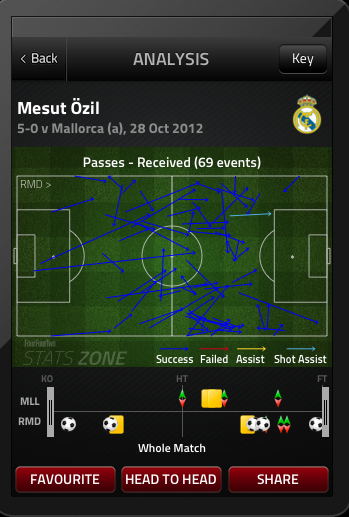
Ozil started centrally for Madrid but he does not tend to stay there. He is given almost a free role as he comes searching for the ball. The amount of wandering Ozil does into different positions is shown below by the positions he is in when he receives the ball. He does not seem to favour one flank over the other or make predictable movements. His movements are equally distributed over both flanks and receives a lot of passes deep. His movements to vacate the central area of the pitch are very useful as it allows Ronaldo to come centrally into the open space or else cut in from the left onto his favoured left foot.


 The vast amount of movement Ozil made at Madrid gave defenders a real conundrum. They could either choose to follow him and risk being dragged out of position, allowing the likes of Ronaldo more time and space. The other option was to hold their positions leaving Ozil unmarked and as a result of this he would often receive the ball in dangerous areas where he could hurt teams, gaining his assist master reputation.


The current kings of Europe Bayern Munich have an altogether different number 10. Whereas Ozil is about movement and assists Toni Kroos is the master of the pass in the role. He is developing a fine reputation as perhaps the most tidy player in Europe when played in the hole. He combines with the likes of Schweinsteiger and the two Bayern wing backs to make sure Bayern keep possession. We analysed another 5-0 victory, this time for Bayern vs Hannover on the 24th of November 2012.


Kroos starts in the hole but his movement is away from goal. The shaded area around him illustrates the zone in which he mostly operates from.  The German plays with his back to goal more often than not, ensuring that Bayern retain and recycle possession. One of the key elements to Bayern’s play is the wide men. They possess real quality out wide with Ribery, Muller and Robben on the wings and Lahm and Alaba backing them up. Below is Kroos’ passing chalkboard from that game.


 Notice the left channel and the amount of attempted passes through that channel between the opposition centre back and full back? This type of pass is for a wide man like Ribery or an overlapper like Alaba and in the end provided very fruitful for Kroos gaining him an assist and setting up a number of shots. Kroos operates a lot deeper than other number 10’s and is more instrumental in the build up play.


5-0’ seem to be the pattern and the final analysis comes from last season’s match between Borussia’s Dortmund and Monchengladbach. Keep an eye on the shaded area around Gotze.


Dortmund start with the now Bayern man Mario Gotze in the hole for them. Dortmund have a real goal threat in Lewandowski but he is missing for this game so an extra something is needed up front. Below is the passes received by Gotze during the game. Correlate the received passes with the shaded area on the Dortmund line up. Gotze totally vacates this area during the game. He does not take up a central position at all. Gotze’s strength in the game is coming from a central area to the flank, a role that wasn’t too dissimilar to Wesley Sneidjer in the Inter Milan team in 2010.


 This is very dangerous for the opposition as Gotze is then able to combine with Marco Reus and Kuba on the flanks. Reus finishes the game with 2 goals. Doubling up on the wing backs, coupled with the dangerous pace and trickery Gotze and Reus possess can cause defences a whole host of problems.

The scary part about this German side is that Lewis Holtby, Max Kruse, Julien Draxler and a few others have still to be majorly tested at international level, yet the signs are present that these players can be just as talented as the three mentioned above. Germany have a plethora of talent and nobody sums up the transformation of the 4-2-3-1 as well as the Germans. 

The Best Still To Come From Dortmund

With the Champions League season about to get under way, a look at last seasons runners up, who we might not have seen the best of yet.


Its amazing to think that Dortmund finished last season trophy-less. They failed to defend their German crown being replaced by Bayern as kings of Germany and were also piped to the European crown by the Bavarians. Despite this, Dortmund enjoyed an amazing surge in popularity and recognition that was long overdue, having impressed no-end two seasons in a row prior to last year. Only now however after failure is Klopp receiving the plaudits he deserves for building such a talent ridden squad on a budget  smaller than many other European rivals.


There is an air of optimism surrounding Dortmund, last season they came so close, but instead of having finality about it, (all good things must come to an end.) There is instead a new breath of fresh air for Dortmund. A real feeling that last season was just the beginning of something successful. Not many clubs could lose in the Champions League final, lose their league crown and lose their best player yet come out the other side appearing stronger.


One key element of this is the fact that Klopp has built a young squad, rather than a team whose best days are behind them. Dortmund are yet to reach their potential best. Of the side that started the Champions League final only the Goalkeeper Weidenfeller was over the age of 30. They lost their key player in Mario Gotze, but this is nothing new to Klopp. In the last 3 seasons he has lost his best player every summer. Sahin, Kagawa and then Gotze all left the club, one has returned (on loan) and there is an inevitability that a return is imminent for the other.


A similar situation to loosing Gotze was when Spurs sold Modric two seasons back. Instead of replacing him with one like for like replacement they instead replaced him with a few players which in turn gave the side more variety and choices. Something similar has happened in Klopp’s strategy. One of Gotze’s strength was his ability to play both wide and centrally behind the striker. Henrikh Mkhitaryan was purchased after a very impressive season both domestically and on the continent, and he looks to fill the void left by Gotze centrally. In addition to the Armenian (as seen in the first game of the season) Klopp can also push players higher up the pitch. In particular Ilkay Gundogan graduated from the central of midfield to the apex of the midfield triangle with prodigal son Nuri Sahin coming in. Aubemeyang had a stand out season in Ligue 1 last year and Klopp brought him in as competition for Lewandowski. This was a smart move because Julian Schieber hasn’t really challenged the Pole effectively. Like Schieber, Aubemeyang also gives Klopp wide options with his blistering pace and his goal scoring exploits.


Blaszczykowski continues to impress with his craft and incredible workmanship out wide, he finished last season with 12 assists. Despite this Kuba has never really been valued as high on the continent as he has to Dortmund fans, but there is absolutely no doubting his importance to Klopp’s side. No other player sums up the equilibrium between ability and work rate so valued by Klopp than Blaszczkowski. Groβkreutz is another who has similar qualities, he is a natural left winger by trade but has effortlessly filled in the right back slot made vacant by Piszczek’s injury.


Dortmund has received another boost out wide with the youngster Jonas Hofmann. The youngster changed the game when brought on against Eintracht Braunschweig scoring and then winning a penalty. The 21 year old graduated from the Dortmund youth team after being purchased from Hoffenheim and has bolstered their options out wide which is their strongest area of attack.

Dortmund are four games in domestically and have maximum points. They sit on top of the Bundesliga as Bayern have dropped two points. The appointment of Guardiola invigorated an already energised Munich but one minor drawback is that Guardiola has made changes to the style of play. Changing a winning formula may cause problems and may result in a few dropped points here and there. Dortmund have kept a formula and a style which has proven that it works for them and they have added to it, strengthening in a number of positions as mentioned before. Klopp also added the former Milan defender Sokratis to his ranks from Werder Bremen to give more of a challenge and more options to his backline.


Having strengthened smartly and well, the upcoming Champions League campaign is filled with both expectation and optimism for a young Dortmund side gaining more experience at every turn. They made a huge pre-tax profit as a result of last season’s so should disaster strike Klopp has resources in January. With all these variables added up, for the North-Rine based club and perhaps for European football in general, the future is bright, the future is black and yellow.

Wednesday, 21 August 2013

Edin Dzeko gives Pellegrini food for thought


It is unusual to discuss a club at the start of a new season and wonder where last season’s top goal scorer fits in. This is the current situation surrounding Manchester City and their Premiership top scorer from last season Edin Dzeko. Last season by all accounts Roberto Mancini preferred his other options over the Bosnian. Tevez had 28 starts and 6 sub appearances and fellow Argentinean  Aguero managed 22 with 8 sub appearances. Dzeko managed just 16 starts and 16 sub appearances. The Bosnian was used just as much as from the bench as he was from the start.


In spite of this he managed 14 Premiership goals, two more than Aguero and one more than Tevez. Rickie Lambert & Frank Lampard where described as having fantastic seasons with a goal tally of 15, Theo Walcott who netted the same amount as Dzeko was hailed for his fruitful season in front of goal but yet Dzeko wasn’t being talked about in the same voice.


City saw Balotelli depart in January and this was followed by Carlos Tevez at the start of the summer both headed to Italy to seek pastures new. Dzeko was linked with moves away but nothing concrete materialised and things looked bleak for the hitman when City recruited Jovetic and Negredo, the pair looked to further push Dzeko down the pecking order. Dzeko is not helped however by City’s preferred system as it tends to favour the lone striker and Dzeko isnt suited to a wide role in this system, one in which Balotelli and Tevez were often sacrificed to and one in which Jovetic may thrive in.


Instead under the new Pellegrini on Monday we saw an excellent use of the 4-4-2 by City. They managed to still get players forward and also managed to keep a solid midfield base to protect the back 4. Zabaletta was still even allowed license to maraude forward and cause havoc. Dzeko was the stand out performer however. The only thing the Bosnian did not do was put the ball in the net and he was correctly identified by SkySports as man of the match.

In football many clichés exist. One of the most common is the phrase “he has good feet for a big man”, and although trying to avoid the use of this cliché with Dzeko it seems it was designed to describe him. Pellegrini’s change to a 4-4-2 (albeit with plenty of rotation and movement) saw Aguero the deeper of the forward pairing and Dzeko the main threat.  New signing Jesus Navas is a genuine winger and offers City an option that they did not have before, and you can see the main supply to Dzeko by the Spaniard is dangerous crosses which Dzeko loves to attack.


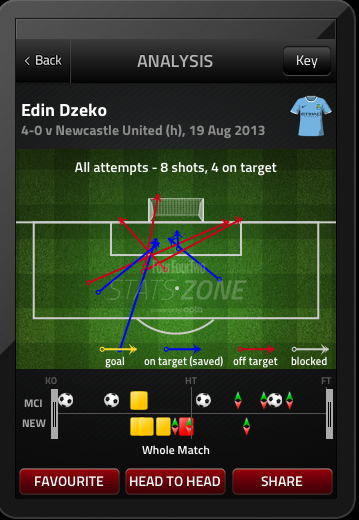
 Throughout the game Dzeko had 8 shots, half of them where headers which shows the varied nature of his play. He is equally comfortable peppering the goal with shots from inside the box like a genuine penalty box poacher as he is using his considerable height getting on the end of crosses.


Zabaletta offers City a unique threat as he is a wing back who likes to overlap on the inside. One particular example of this coming to effect was the goal against QPR for 1-0 when City won the league on that last day. Wheras Navas will whip crosses into Dzeko for him to attack, Zabaleta will come in the inside and look to find the Bosnian’s feet inside the area. Against Newcastle the most frequent source from which Dzeko received the ball was from Zabaleta  (7 times)and then from Navas (4). The positions Dzeko received his passes from Zabaleta also shows a side to his play, his workrate and willingness to run the channels rather than simply operate centrally. This fits Pellegrini’s 4-4-2 style with plenty of movement and positional rotation.


Many thought Dzeko would be frozen out at City, that he was not suited to the clubs style and that the manager would favour more well regarded superstars over the undoubtedly talented Dzeko. Despite less chances the Bosnian got more goals for the club last season than his positional rivals, and the manner of his play on Monday night, coupled with how high his performance was, means that Edin Dzeko could in fact be in for huge make or break season in the blue of City.